

Quick Summary
In this guide, you’ll learn:
✔️ How real-time object detection works
✔️ How to use YOLOv4-Tiny and YOLOv8 for fast inference
✔️ How to build Algerian-specific datasets
✔️ How to run real-time detection with a simple laptop and webcam
✔️ How to optimize FPS and reduce latency
✔️ Deployment options for desktop, mobile, edge devices
✔️ Bonus : Build an online AI-powered platform with Ayor.ai.
Why real-time object detection matters in Algeria
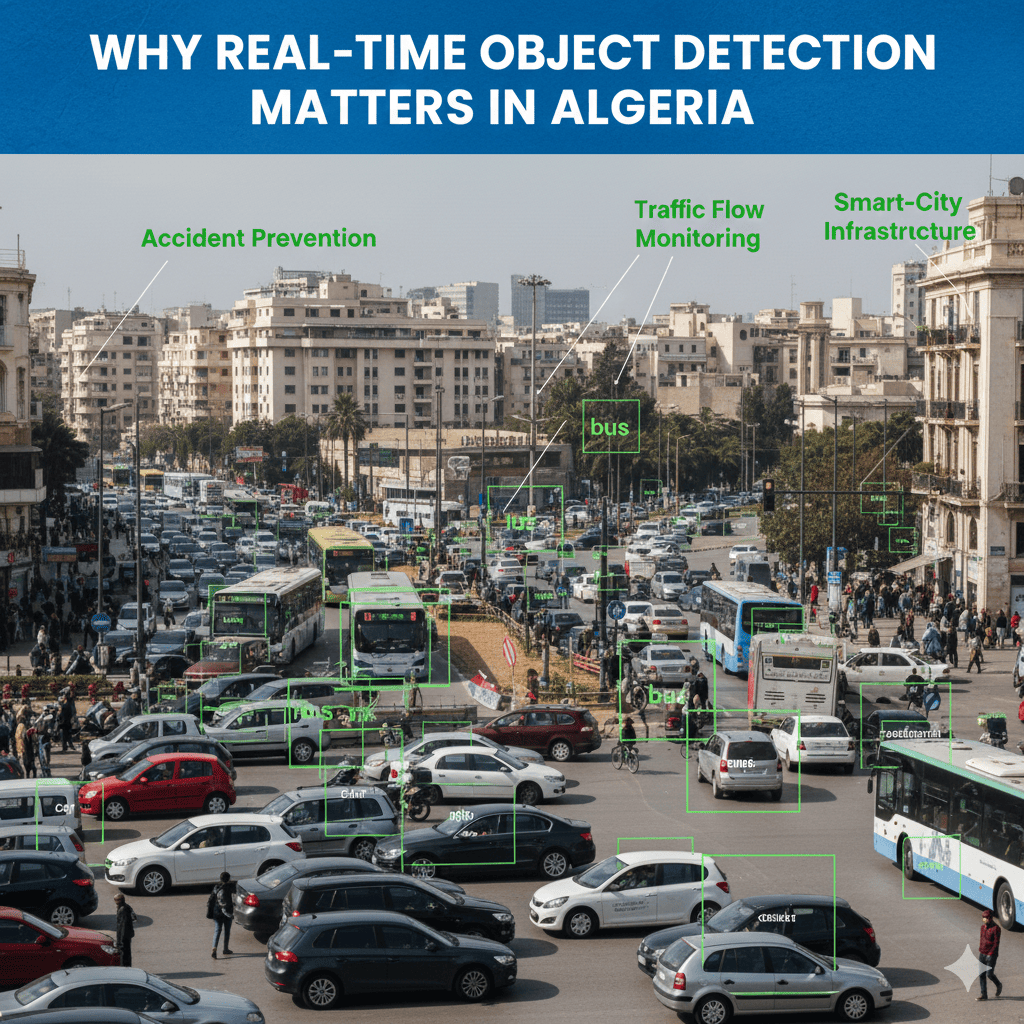
Road accidents remain one of the most critical safety issues in Algeria.
Fast highways, crowded intersections, busy pedestrian crossings, and inconsistent road signage make computer vision a necessity.
Real-time object detection helps:
- Prevent accidents
- Monitor traffic conditions
- Power smart-city infrastructure
- Enable ANPR, lane monitoring, traffic violation detection
Models like YOLOv4-Tiny (extremely fast) and YOLOv8 (modern and accurate) allow you to deploy real-time AI systems using nothing more than a laptop and a camera.
What is real-time object detection ?
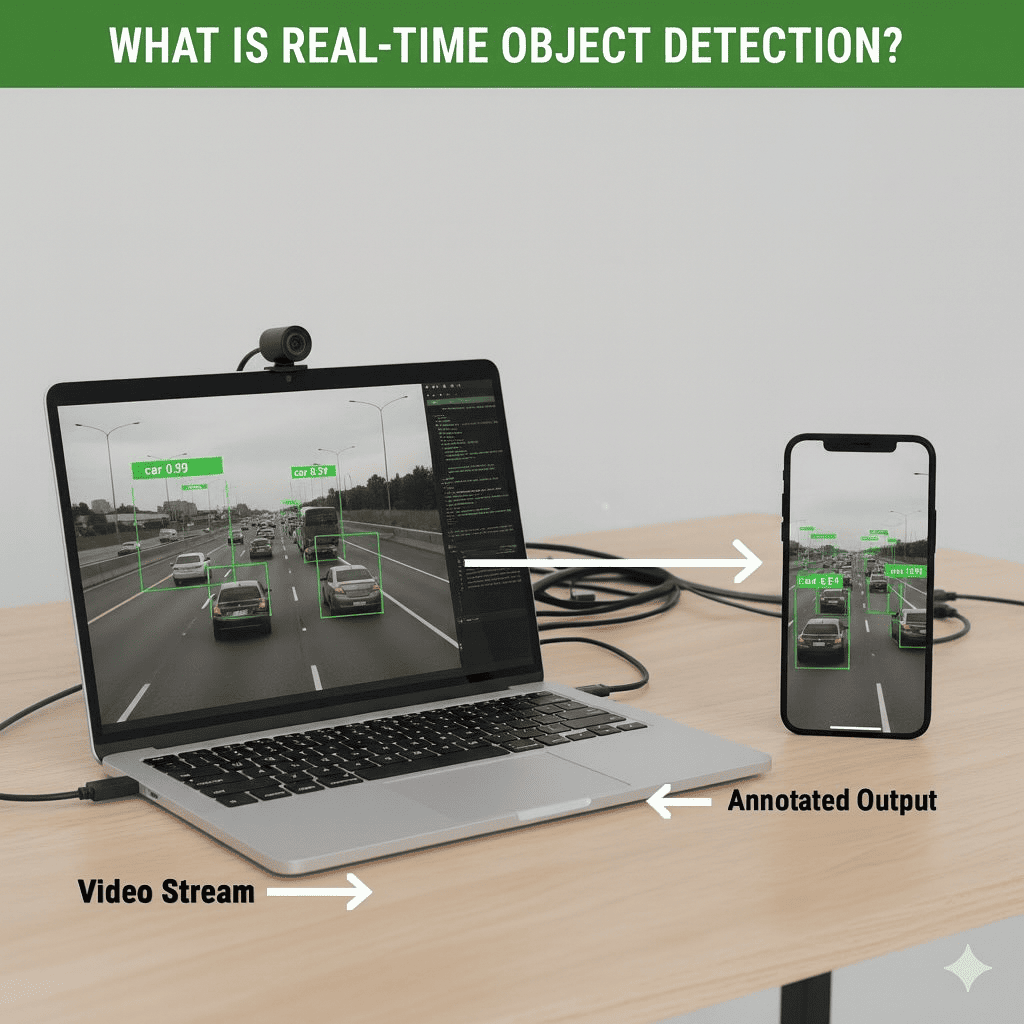
Real-time object detection is the process of identifying objects inside a video stream fast enough to keep up with live movement.
In the Algerian context, this matters because it enables:
- Traffic monitoring
- Road-safety automation
- Highway analytics
- Smart transportation systems
A real-time system must provide:
- 15–60 FPS performance
- Low latency
- Lightweight and efficient models
Tools you need
Here’s the essential toolkit to get started:
Core tools:
- Python 3.8+
- OpenCV
- YOLOv4-Tiny
- YOLOv8 (Ultralytics)
- A webcam / USB camera / IP camera
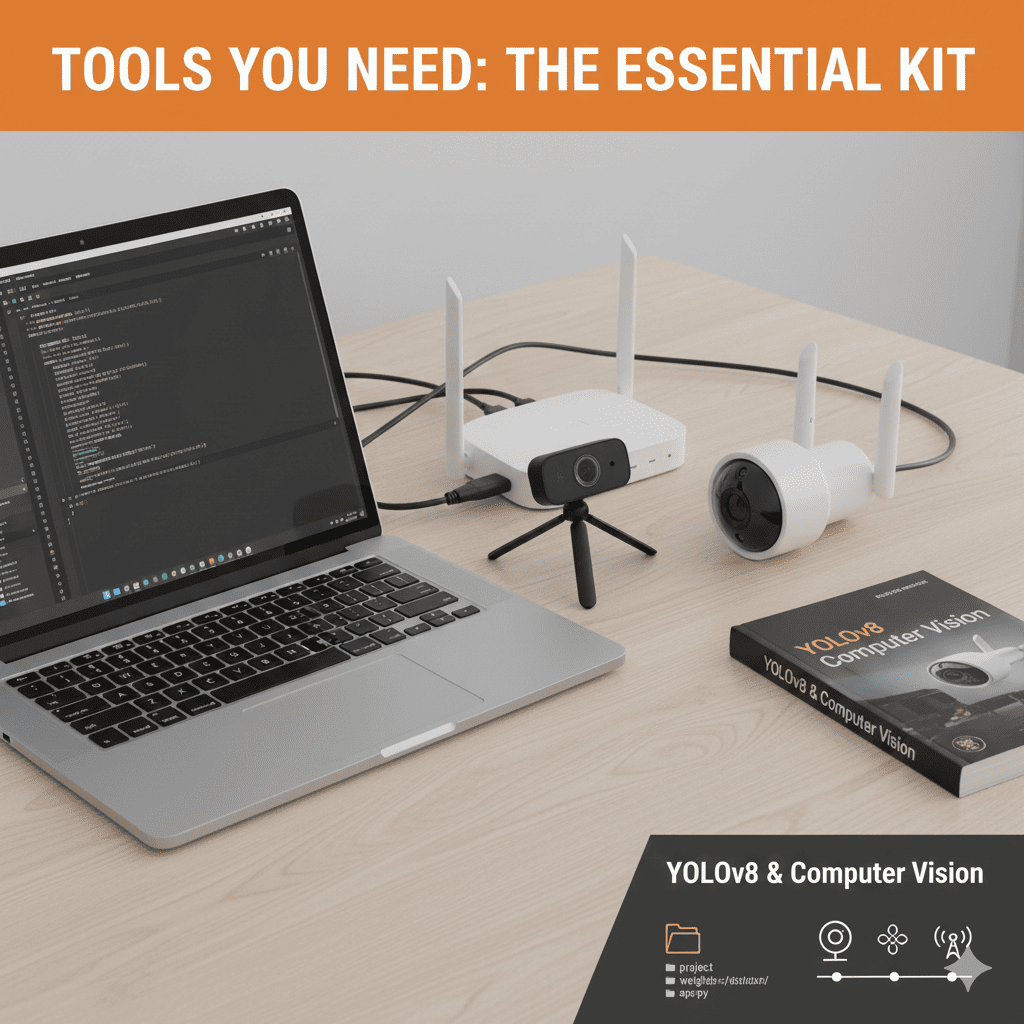
This setup is fully enough to run high-speed inference on Algerian roads (Algiers, Oran, Constantine, etc.).
Preparing your dataset
A strong dataset is the foundation of a strong model.
Algerian data sources
- Your own dashcam or smartphone footage
- ADET datasets
- RoboFlow Algerian traffic datasets
- Recorded urban and highway videos
You can check these links :
- Vehicles traffic recordings on public road (Oran, Algeria) – Mendeley Data.
- Dataset of traffic signs and lights, reportedly including Algerian roads.
- Algerian License Plate 500 Dataset
- General traffic / road‑traffic / video datasets on public CV platforms (from e.g. other public datasets, global traffic datasets)
Note : Make sure to anonymize faces and license plates if needed.
Labeling tools
Best practices
- Use simple classes: car, bus, pedestrian, traffic sign
- 500–3,000 images are enough for a small custom model
- Include diversity: day/night, rain, highways, roundabouts
- Use an 80/20 train-test split
Setting up your environment
Install dependencies:
pip install opencv-python ultralytics numpyFor YOLOv4-Tiny, download:
.cfgfile.weightsfile.namesfile
Test your webcam
import cv2

cap = cv2.VideoCapture(0)
while True:
    ret, frame = cap.read()
    cv2.imshow("Webcam", frame)
    if cv2.waitKey(1) & 0xFF == 27:
        break
cap.release()
cv2.destroyAllWindows()
Recommended Project Structure
project/
 ├── weights/
 ├── yolo4/
 ├── yolo8/
 ├── data/
 ├── app.py
Running YOLO models (Inference code)
YOLOv4-Tiny inference code
import cv2
import numpy as np

net = cv2.dnn.readNet("yolov4-tiny.weights", "yolov4-tiny.cfg")
classes = [line.strip() for line in open("obj.names")]

cap = cv2.VideoCapture(0)

while True:
    _, frame = cap.read()
    blob = cv2.dnn.blobFromImage(frame, 0.00392, (416,416), swapRB=True)
    net.setInput(blob)
    outs = net.forward(net.getUnconnectedOutLayersNames())

    for out in outs:
        for det in out:
            scores = det[5:]
            class_id = np.argmax(scores)
            conf = scores[class_id]
            if conf > 0.5:
                x, y, w, h = det[0:4] * np.array([frame.shape[1], frame.shape[0], frame.shape[1], frame.shape[0]])
                cv2.rectangle(frame, (int(x-w/2), int(y-h/2)), (int(x+w/2), int(y+h/2)), (0,255,0), 2)

    cv2.imshow("YOLOv4-Tiny", frame)
    if cv2.waitKey(1) == 27:
        break
YOLOv8 inference code
from ultralytics import YOLO
import cv2

model = YOLO("yolov8s.pt")
cap = cv2.VideoCapture(0)

while True:
    ret, frame = cap.read()
    results = model(frame, conf=0.5)

    annotated = results[0].plot()
    cv2.imshow("YOLOv8", annotated)

    if cv2.waitKey(1) == 27:
        break
Optimizing your real-time pipeline
Pipeline steps
- Capture frame
- Preprocess
- Run inference
- Draw bounding boxes
- Render output
Performance tips
- Use GPU acceleration (CUDA) if available
- Lower input resolution (e.g., 320×320)
- Prefer YOLOv4-Tiny on low-power devices
- Enable frame skipping
- Use multithreading for capture + inference
Expect 15–40 FPS depending on your hardware.
Use cases in Algeria
Real-time object detection unlocks valuable applications for smart mobility:
Traffic monitoring
Detect violations, track vehicle density, measure congestion.
Highway analytics
Speed detection, lane tracking, incident detection.
Parking management
Real-time space availability detection.
ANPR systems
Automatic number plate recognition for tolls and enforcement.
Algeria is moving toward smart-city infrastructure, and these solutions can accelerate that transition.
7 expert tips for better real-time detection
- Use INT8 quantization for 2× faster inference
- Apply frame skipping on low CPUs
- Add a tracker like SORT
- Train on night-time Algerian footage
- Use regions of interest (ROIs)
- Benchmark on CPU vs GPU
- Use YOLOv4-Tiny or YOLO-Nano for Raspberry Pi
Deployment options
Let’s explore the best deployment choices.
Desktop app
Using PyQt, Tkinter, or Streamlit.
Mobile
Convert YOLOv8 to ONNX → TensorFlow Lite.
Raspberry Pi / Jetson
Jetson Nano = ideal for Algerian smart-city prototypes.
Cloud API
FastAPI + GPU server for national-scale apps.
Bonus: Build an online platform around your AI system
If you’re planning to create a web interface, showcase your AI projects, or even sell hardware or AI-based services, you’ll need a reliable store builder.

🔥 If you’re looking to build a high-performing online store while keeping things simple, check out Ayor.ai.
It’s an AI-powered e-commerce platform designed to help you launch, optimize, and scale your store in Algeria or globally.
From automation to product optimization and AI assistants, Ayor.ai gives you the tools to grow efficiently and stay focused on what matters: your results.
👉 Try it here: ayor.ai
Conclusion
To recap, here’s what you learned:
- Why detection matters on Algerian roads
- Tools needed to get started
- Dataset preparation and labeling
- YOLOv4-Tiny vs YOLOv8 practical code
- Real-time optimizations
- Deployment choices
With the right dataset and a clear pipeline, you can build powerful AI apps that improve road safety and mobility for everyone. Start experimenting today and unleash the power of real-time object detection.
Start your journey to become a data-savvy professional in Algeria.
👉 Join the Around Data Science community, subscribe to our newsletter, and follow us on LinkedIn to stay updated.



0 Comments