
SQL for Data Science is a core skill every student must master before applying for data jobs, and this guide highlights the essential queries you need to know to stand out. SQL remains the backbone of modern data analysis and plays a central role in every data science workflow.
In this article, you’ll explore the most important SQL queries used in interviews and real-world projects, including SELECT statements, JOINs, aggregations, subqueries, and advanced analytical techniques. Clear examples, practical use cases, and hands-on code snippets will help you build confidence for both technical assessments and day-to-day data tasks.
What is SQL for data science ?
SQL (Structured Query Language) is a standard programming language used to communicate with relational databases. In data science, SQL is crucial for extracting, manipulating, and analyzing data stored in tables. Unlike tools like Excel, SQL can handle millions of rows efficiently and allows you to perform complex operations quickly.
Data scientists rely on SQL to:
- Extract raw data for analysis.
- Perform data cleaning and preprocessing.
- Generate insights with aggregations and joins.
- Integrate datasets from multiple sources.
Whether you are working with MySQL, PostgreSQL, SQL Server, or even BigQuery, knowing SQL is a baseline requirement for data roles.
Why is SQL important for data science students ?
Learning SQL is not just academic, it’s career-critical. Here’s why:
- Industry Standard: Most companies store structured data in relational databases.
- Interview Requirement: SQL skills are tested in almost every data science interview.
- Data Manipulation Efficiency: It simplifies complex data transformations.
- Integration with Python & R: SQL seamlessly interacts with pandas, NumPy, and other data science libraries.
- Foundation for Advanced Analytics: Knowledge of SQL is often a prerequisite for learning data warehousing, ETL processes, and MLOps pipelines.
Without SQL, extracting meaningful insights from raw data becomes slow and error-prone.
Read more : An Excellent Machine Learning Pipeline : Don’t Search Out – Around Data Science
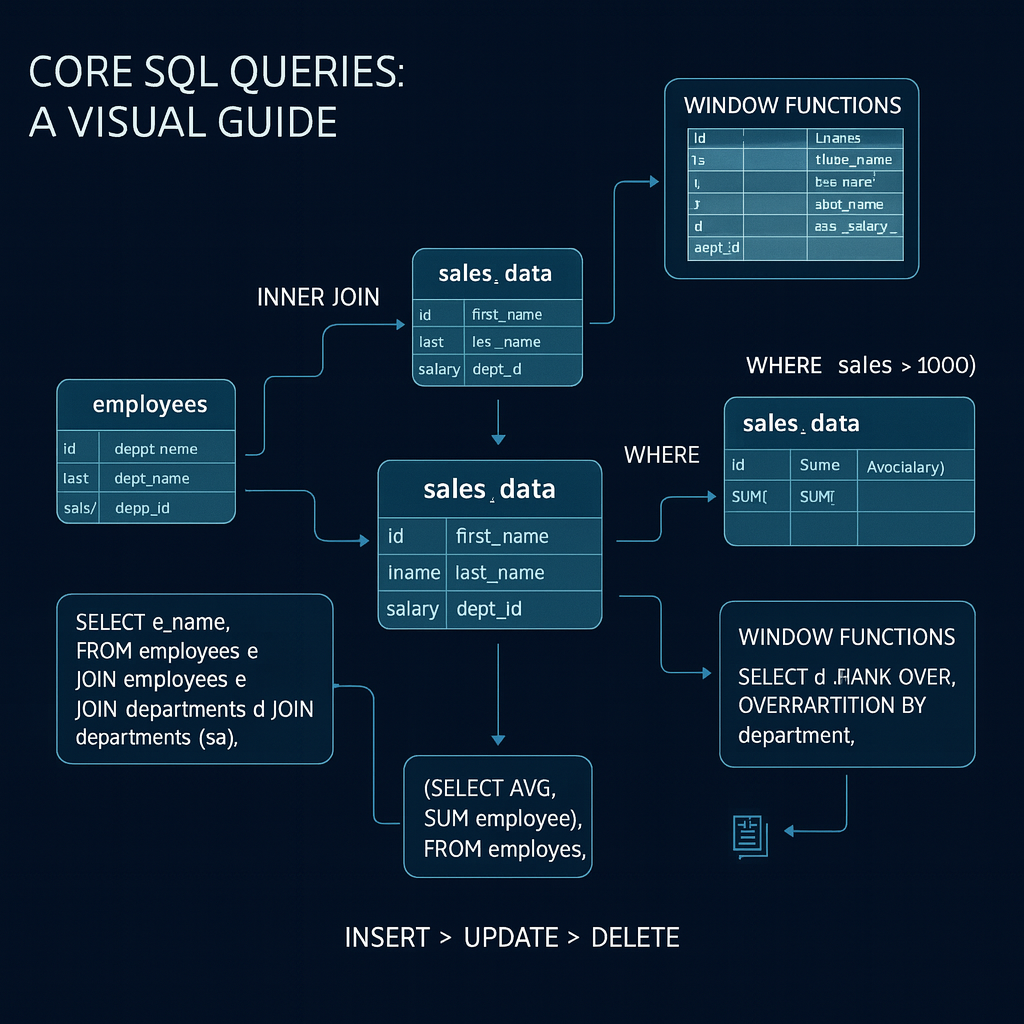
Core SQL queries every student should master
1. Basic SELECT queries
The SELECT statement is the foundation of SQL.
-- Fetch all columns from the employees table
SELECT * FROM employees;

-- Fetch specific columns
SELECT first_name, last_name, salary FROM employees;
Tips:
- Use
LIMITto preview large tables. - Always specify columns to improve performance.
2. Filtering with WHERE
Filtering data is essential for analysis.
-- Find employees with salary above 50000
SELECT first_name, last_name, salary
FROM employees
WHERE salary > 50000;
Operators to know:
=,!=,>,<,>=,<=BETWEEN,IN,LIKE,IS NULL
3. Aggregations and GROUP BY
Aggregations help summarize data.
-- Total salary by department
SELECT department_id, SUM(salary) AS total_salary
FROM employees
GROUP BY department_id
ORDER BY total_salary DESC;
Common aggregate functions: SUM(), AVG(), COUNT(), MIN(), MAX().
4. JOINs: Combining multiple tables
Real-world data is rarely in a single table.
-- Inner join employees with departments
SELECT e.first_name, e.last_name, d.department_name
FROM employees e
INNER JOIN departments d ON e.department_id = d.department_id;
Join Types:
INNER JOIN: Matching rows onlyLEFT JOIN: All rows from left tableRIGHT JOIN: All rows from right tableFULL OUTER JOIN: All rows from both tables
5. Subqueries
Subqueries allow nested queries for complex operations.
-- Employees earning more than average salary
SELECT first_name, last_name, salary
FROM employees
WHERE salary > (SELECT AVG(salary) FROM employees);
6. Window functions
Window functions provide advanced analytics over partitions.
-- Rank employees by salary within departments
SELECT first_name, last_name, department_id,
       RANK() OVER(PARTITION BY department_id ORDER BY salary DESC) AS dept_rank
FROM employees;
Common functions: ROW_NUMBER(), RANK(), DENSE_RANK(), LEAD(), LAG().
7. Data manipulation: INSERT, UPDATE, DELETE
While analysis mostly requires SELECT, manipulation is important for real-world tasks.
-- Insert a new employee
INSERT INTO employees (first_name, last_name, department_id, salary)
VALUES ('Ali', 'Bendimerad', 3, 55000);

-- Update salary
UPDATE employees
SET salary = 60000
WHERE employee_id = 101;

-- Delete a record
DELETE FROM employees
WHERE employee_id = 102;
Explore : Decision Tree Classification in Python : A Complete Beginner-Friendly Guide – Around Data Science
7 Bonus tips for mastering SQL for data science
- Practice with Real Datasets: Use Kaggle or public databases.
- Write Queries Daily: Consistency improves recall.
- Learn Indexing: Optimize queries on large datasets.
- Master CTEs (Common Table Expressions): Simplifies complex queries.
- Use SQL with Python/R: Integration skills are highly valued.
- Understand Database Design: Know normalization vs denormalization.
- Time-Series Queries: Learn to manipulate dates and windows for analytics.
SQL for data science: Practical use cases
- Business Analytics: Revenue by product, customer segmentation.
- Machine Learning Pipelines: Feature extraction directly in SQL.
- ETL Workflows: Clean and prepare datasets for analysis.
- Data Visualization: Pre-aggregate data for dashboards in Tableau or Power BI.
Common SQL mistakes to avoid
| Mistake | Description | Fix |
|---|---|---|
| SELECT * in production | Inefficient on large tables | Specify only required columns |
| Forgetting JOIN conditions | Leads to cartesian product | Always use ON clause |
| Ignoring NULLs | Can skew results | Use IS NULL / COALESCE |
| Overusing subqueries | Slows performance | Use CTEs or JOINs instead |
FAQ
1. What is the importance of SQL in data science?
SQL allows data extraction, transformation, and analysis, essential for any data role.
2. Which SQL queries should every data science student know?
SELECT, WHERE, GROUP BY, JOINs, subqueries, and window functions are must-know queries.
3. Can SQL be used with Python for data science?
Yes, libraries like pandas, SQLAlchemy, and psycopg2 allow seamless integration.
4. Are advanced SQL skills required for data science jobs?
Advanced skills like CTEs, window functions, and optimization improve performance and interview readiness.
5. How can I practice SQL effectively?
Use real datasets from Kaggle, practice SQL exercises, and contribute to projects requiring database analysis.
6. What is a common SQL mistake students make?
Using SELECT * in production, forgetting JOIN conditions, or ignoring NULL values.
7. How does SQL help in machine learning pipelines?
SQL helps extract and preprocess features, aggregate datasets, and handle large-scale data efficiently.
Conclusion for SQL for data science
- SQL is essential for data extraction, cleaning, and analysis.
- Master SELECT, WHERE, JOINs, GROUP BY, subqueries, and window functions.
- Practice real-world datasets and integrate SQL with Python/R.
- Avoid common mistakes like
SELECT *and missing JOIN conditions. - Advanced techniques improve efficiency and interview performance.
By mastering SQL for data science, students gain the skills necessary to excel in technical interviews and data projects.
👉 Join the Around Data Science community (Discord), subscribe to our newsletter, and follow us on LinkedIn.


0 Comments