
AI for people in a hurry is now a necessity, not a luxury. It’s advancing so quickly that even experts struggle to keep up. In Algeria, companies across banking, telecom, tech, and public services (the last one is still lagging for now, but we’re optimistic LOL) are adopting AI at record speed.
Yet most explanations online are full of jargon, long theories, and confusing math. Many professionals with basic Python knowledge still find AI concepts unclear or overwhelming.
This guide solves that problem. You’ll get a clear, fast, professional, Algerian-friendly explanation of what AI is, how it works, how to use it, and how to build a career in it, without wasting hours.
Ready to understand AI in minutes ? Let’s dive in.
What is AI for people in a hurry?
AI is the science of making machines perform tasks that normally require human intelligence. But what does this truly mean for you as an Algerian professional?
Let’s break it down simply.
What AI actually means
AI is a system that learns from data and makes decisions.
It mimics human thinking patterns such as recognizing images, understanding text, or predicting behavior.
But people often confuse AI, Machine Learning, and Deep Learning. Here’s the simple distinction:
- AI → The broad field. Anything that makes machines “smart.”
- Machine Learning (ML) → A subset of AI that learns patterns from data.
- Deep Learning (DL) → A powerful subset of ML that uses neural networks to learn complex patterns (vision, speech, language).
Why the confusion?
Because most modern AI applications (chatbots, face recognition, autonomous driving) use ML or DL, so people mix all the terms.
AI in 60 seconds
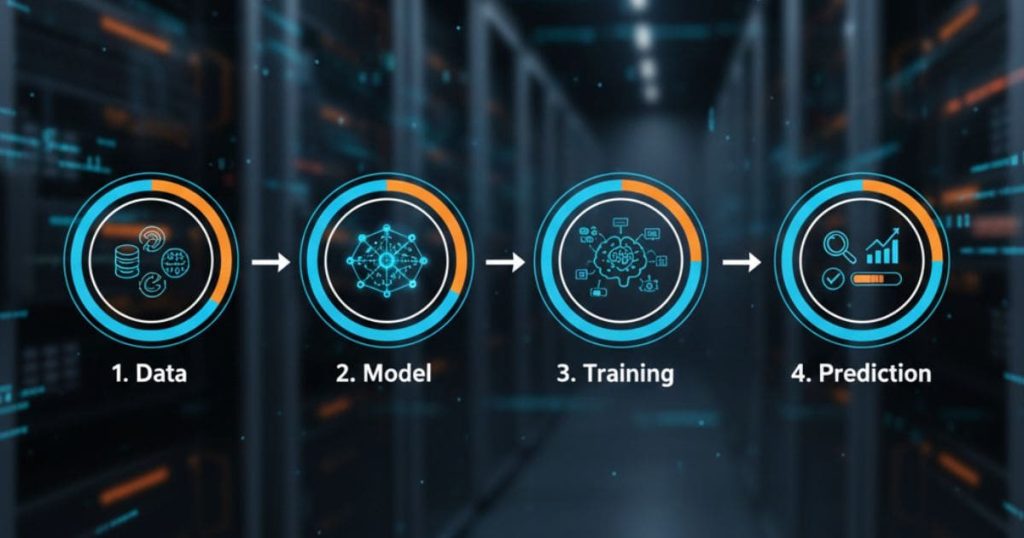
AI follows a simple workflow. In fact, just four steps:
- Data → Collect and clean relevant data.
- Model → Choose a model (decision tree, neural network…).
- Training → Feed data to the model so it learns.
- Prediction → Use the trained model to make decisions.
A real Algerian example
Fraud detection in Algerian banking.
Banks like CPA, BEA, and private institutions use ML models that monitor transactions.
The model learns from:
- User history
- Transaction patterns
- Spending location
- Time of transactions
Then it predicts: “Is this behavior normal or suspicious?”
If suspicious, the system triggers verification instantly.
That’s AI at work, simple, fast, and practical.
📌 We’ve put together a free ebook showcasing Algerian companies already using AI, along with simple explanations for all the AI jargon you might encounter. If you want the full story, make sure to check it out : AI For People in a Hurry : Introduction to Artificial Intelligence – Around Data Science
Key branches of AI (Simple overview)
1. Machine Learning
Learns patterns from numerical or textual data. Used in pricing, risk scoring, and forecasts.
2. Deep Learning
Learns complex patterns using neural networks. Essential for images, speech, and large-scale predictions.
3. Computer Vision
Extracts information from images or videos. Used in surveillance, industrial inspection, medical imaging.
4. Natural Language Processing (NLP)
Understands and generates human language. Used in chatbots, translation, summarization.
5. Reinforcement Learning
Learns through trial and error. Used in robotics, optimization, gaming, scheduling.

What AI can (and cannot) do
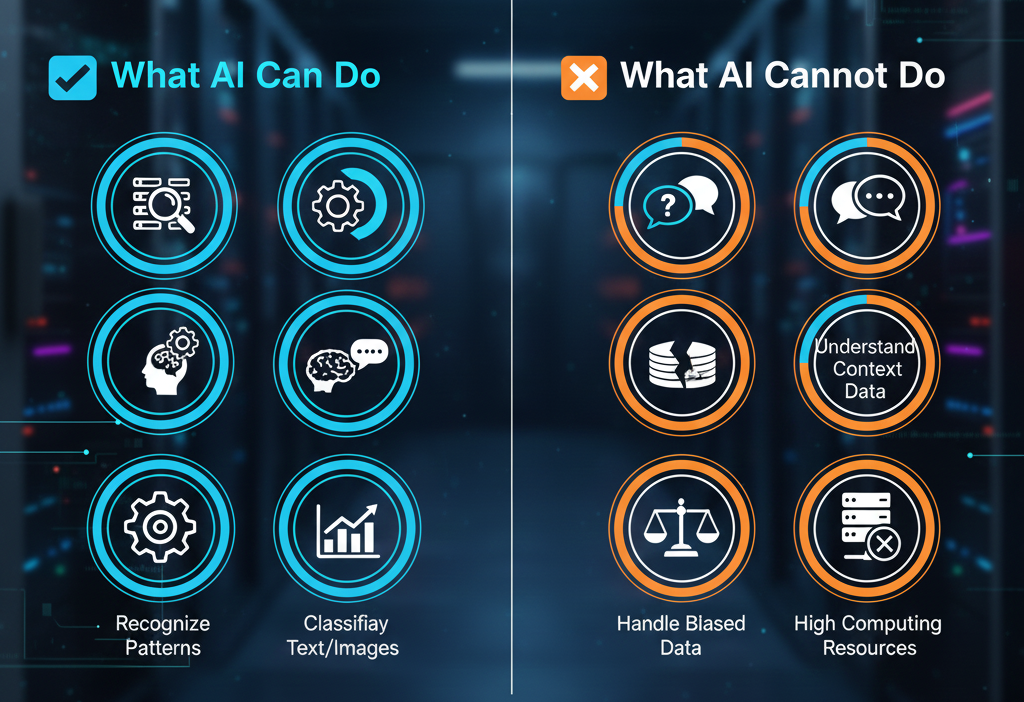
What AI can do
AI excels in:
- Recognizing patterns in large datasets
- Automating repetitive tasks
- Classifying text, images, audio
- Predicting trends (sales, fraud, churn)
- Personalizing content (ads, recommendations)
You see this daily in Algeria:
- Social media content ranking
- Banking fraud alerts
- HR resume filtering
- Telecom churn predictions
- E-commerce recommendations
📘 Discover : Optimizing Agricultural Land Production in Algeria: An AI-Powered Solution – Around Data Science
What AI cannot do
However, AI is not magic. It has limits:
- It cannot understand context like humans do.
- It struggles with incomplete or biased data.
- It cannot reason morally or ethically.
- It often needs huge computing resources.
- It cannot replace critical human decision-making.
The tools behind AI
If you want to work with AI, start with these essentials:
Python
The number-one AI programming language. Simple, powerful, and widely supported.
📘 Read more : Getting Started with the Pandas Python Library in 2025: A Beginner’s Guide with Algerian Use Cases – Around Data Science
Scikit-learn
Best for beginners. Great for classical ML: regression, classification, clustering.
📘 Check : Prediction Metrics: A Deep Dive into Regression & Classification (with Code) – Around Data Science
TensorFlow & PyTorch
Deep Learning frameworks used by professionals, startups, and researchers.
HuggingFace
The home of modern NLP. Thousands of pre-trained models for text, images, audio.
AI careers in Algeria (Fast overview)
AI careers are growing rapidly across Algerian telecom, energy, banking, gov-tech, and startups.
Common roles
- Machine Learning Engineer
- Data Scientist
- Computer Vision Engineer
- AI Product Manager
- ML Ops Engineer
⭐ Check out our DZ tech stars for your next project : Nujum Tech DZ – Around Data Science
Required skills
- Python
- ML algorithms
- Data visualization
- Deep learning basics
- Cloud familiarity (AWS, Azure, GCP)
- Git & version control
Salary ranges (adapted from MENA averages)
- Entry-level (0–2 years): 60,000 – 100,000 DZD/month
- Mid-level (2–5 years): 100,000 – 280,000 DZD/month
- Senior (>5 years): 280,000 – 450,000+ DZD/month
These ranges vary, but they reflect current hiring trends in Algeria for AI talent.
The fastest learning path (For busy people)
If you already know a bit of Python, here’s the quickest route to AI skills:
Step 1: Learn Python properly
Focus on:
- Pandas
- Numpy
- Matplotlib
- Basic OOP concepts
Step 2: Learn Machine Learning basics
Study:
- Linear regression
- Decision trees
- Random forests
- Train/test split
- Cross-validation
📘 For exemple : House Prices Prediction using Linear Regression Model – Around Data Science
Step 3: Build 3 starter projects
Choose small, practical projects:
- Spam classifier
- House-price prediction
- Customer churn model
Step 4: Use free resources
Start with:
- Kaggle
- Coursera free tracks
- Fast.ai
- HuggingFace transformers course
- Around Data Science tutorials
📘 Check out : Python for Data Science: 5 Free Certification Courses You Can’t Miss
Bonus tips for AI for People in a Hurry
Here are 5 expert shortcuts to learn AI even faster:
- Use pre-trained models instead of building from scratch.
- Start with structured datasets before touching deep learning.
- Automate repetitive tasks with notebooks to save time.
- Follow GitHub profiles of top Algerian developers for inspiration.
- Join data communities (LinkedIn groups, Discord servers) for support.
Conclusion for AI for people in a hurry
In summary:
- AI is simpler than you think when explained clearly.
- You only need basic Python to begin.
- Algeria is entering a strong AI adoption phase.
- Careers in AI are growing fast with competitive salaries.
- A focused learning path is the key to quick progress.
Quick checklist for fast AI learning
- Learn Python fundamentals
- Study ML basics
- Build 3 projects
- Explore Deep Learning gradually
- Experiment with HuggingFace models
- Join Algerian AI communities
- Keep practicing weekly
Start your journey to become a data-savvy professional in Algeria.
👉 Subscribe to our newsletter, follow Around Data Science on LinkedIn, and join the community on Discord.


0 Comments