

Logistic regression is a fundamental technique in data science with powerful applications in Algeria and beyond. But what exactly is logistic regression, and why is it so important ?
This article will unravel the concept, its significance, and practical uses to help you master this essential tool. Ready to boost your data skills? Keep reading.
What is logistic regression ?
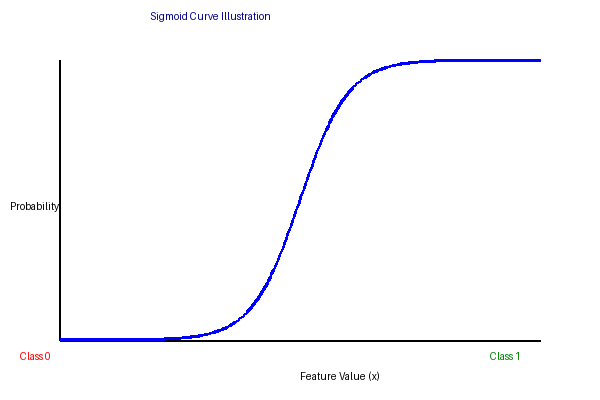
Logistic regression is a statistical method used for binary classification, deciding between two outcomes like yes/no, success/failure, or spam/not spam. Unlike linear regression, which predicts continuous values, logistic regression predicts the probability that an input belongs to a particular category by using a special function called the Sigmoid. This probability ranges between 0 and 1, making logistic regression perfect for classification tasks.
In simple terms, logistic regression helps answer questions like: Will this customer buy a product? Is this email spam? Does this patient have diabetes?
It models the relationship between one or more independent variables and a binary target variable.
Why is logistic regression important ?
Logistic regression is vital because:
- It solves common classification problems faster and with less data than complex algorithms.
- It provides probabilities, which help understand prediction confidence.
- It’s interpretable, showing how each feature influences the outcome.
- It serves as a foundation for more advanced machine learning methods, including neural networks.
For Algerian students and professionals, mastering logistic regression opens doors to work in healthcare, finance, telecom, and more, where binary decisions are key.
How does logistic regression work ?
Logistic regression applies a linear combination of inputs (features) weighted by learned coefficients. It then transforms this result through the Sigmoid function, which outputs a value between 0 and 1 representing probability.
Key steps include:
- Linear equation: Compute weighted sum of features (e.g., age, income).
- Sigmoid function: Convert linear output to probability.
- Classification: Assign to class 1 if probability > 0.5, otherwise class 0.
Simple Python example – Binary classification
pythonfrom sklearn.linear_model import LogisticRegression
from sklearn.model_selection import train_test_split
from sklearn.datasets import load_breast_cancer

# Load dataset relevant to health (breast cancer prediction)
data = load_breast_cancer()
X_train, X_test, y_train, y_test = train_test_split(data.data, data.target, random_state=42)

# Initialize and train model
model = LogisticRegression(max_iter=10000)
model.fit(X_train, y_train)

# Predict on new data
predictions = model.predict(X_test)

print("Predictions:", predictions)
This example shows logistic regression applied in a healthcare dataset, relevant to Algerian students interested in medical data science.
5 Bonus tips for mastering logistic regression
- Feature scaling: Helps improve model training efficiency.
- Regularization: Prevents overfitting by penalizing large coefficients.
- Interpret coefficients: Understand feature importance and direction.
- Evaluate with metrics: Use accuracy, precision, recall, and AUC-ROC.
- Practice with local datasets: Explore Algerian healthcare or telecom data to gain insights.
Conclusion for logistic regression
- Logistic regression is a key binary classification tool widely used in data science.
- It estimates the probability of outcomes using a linear equation and Sigmoid function.
- The method is interpretable, efficient, and foundational for advanced models.
- Practical experience with Python and local datasets enhances learning.
Mastering logistic regression will give you a solid start in data science, especially for tackling real-world problems in Algeria.
Start your journey to become a data-savvy professional in Algeria.
👉 Subscribe to our newsletter, follow Around Data Science on LinkedIn, and join the discussion on Discord.



0 Comments