

A/B testing is one of the most powerful and accessible optimization methods in modern e-commerce.
In Algeria, where online shopping adoption is rapidly growing, even small changes to product pages, images, or checkout experiences can significantly increase conversions.
Yet many Algerian e-commerce businesses still rely on intuition: new banners, product layouts, and checkout designs are often published without testing which version actually performs better.
This article breaks down a realistic A/B test from a typical Algerian online store, showing how data-driven decisions can boost conversions, reduce bounce rate, and improve user experience.
If you run or plan to launch an e-commerce store in Algeria, these insights can help you grow faster and smarter.
What is A/B testing in e-commerce ?
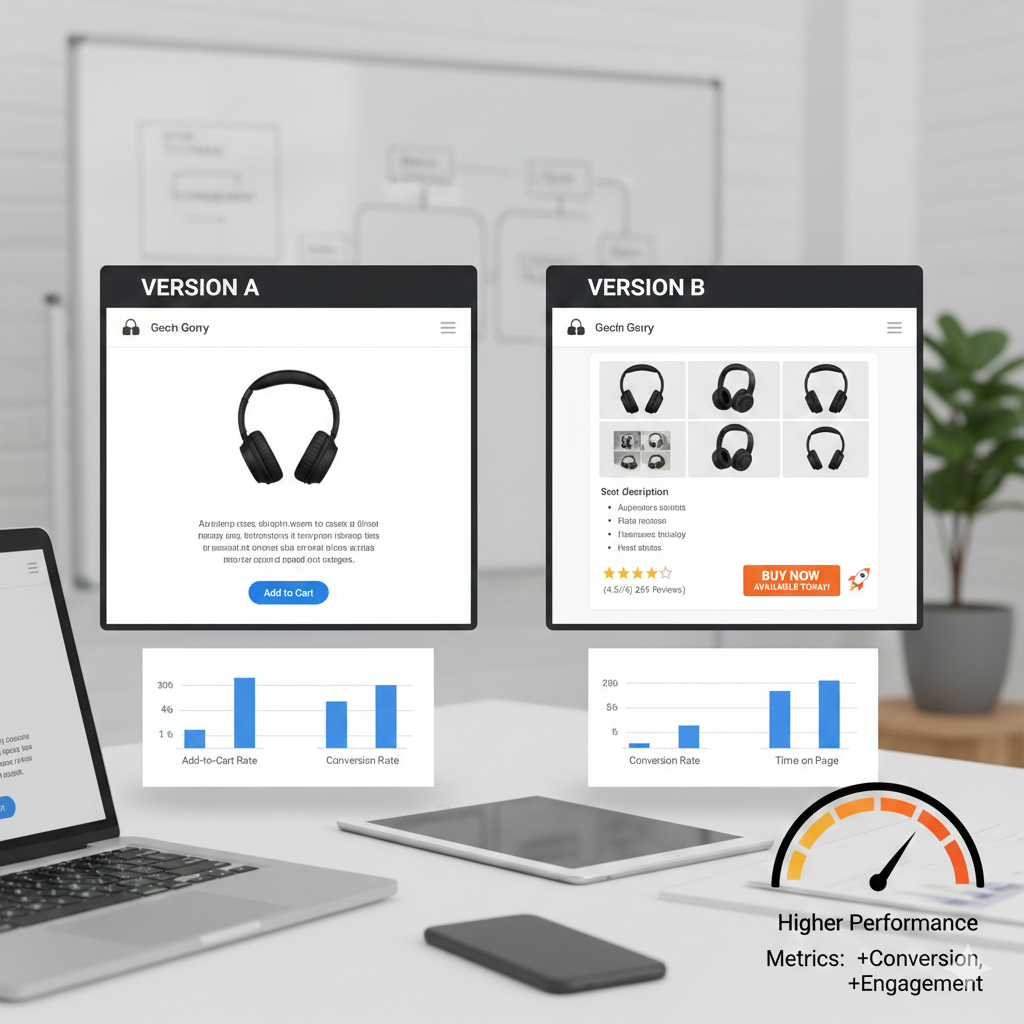
A/B testing (also called split testing) consists of comparing two versions of a webpage:
- Version A: the current/original version
- Version B: a modified version
You then measure which one performs better using metrics such as:
- Add-to-cart rate (ATC)
- Conversion rate
- Click-through rate (CTR)
- Average order value (AOV)
- Bounce rate
- Time on page
- Scroll depth
A/B testing matters even more in Algeria because consumers:
- compare prices across multiple platforms
- rely heavily on visuals and social proof
- often shop from mobile devices
- are sensitive to delivery and availability messages.
A realistic A/B test on a mid-size Algerian e-commerce website
Imagine a typical Algerian online store operating nationwide—we’ll call it DZMarket.
The store sells electronics, fashion, and home appliances, with traffic similar to mid-size Algerian e-commerce players.
🔍 Problem
Many users visited product pages, but very few added items to their carts.
The add-to-cart rate was only 3.1%, below the global average of 4–8%.
The marketing team suspected that the product page layout was not persuasive enough.
They tested two versions:
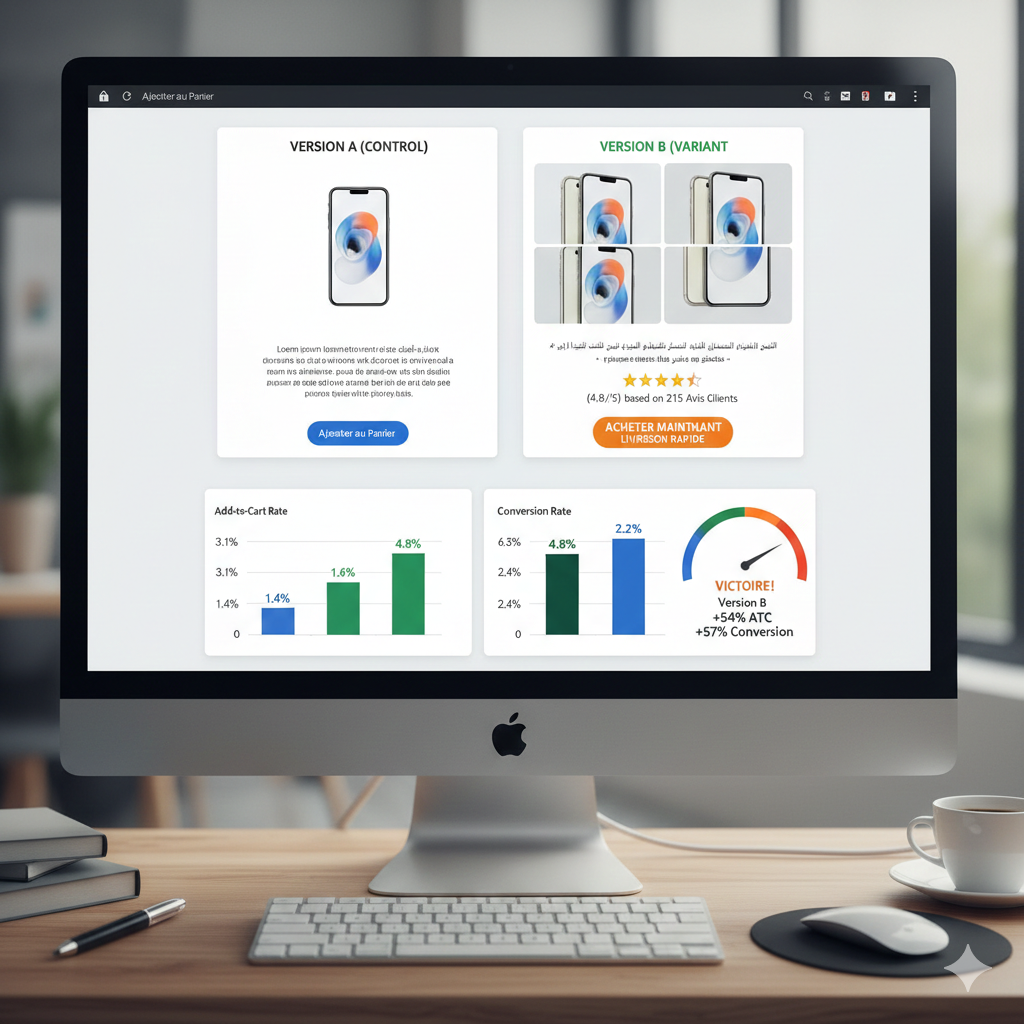
Version A (Control — current product page)
- Single product image
- Description text below
- No social proof
- Standard CTA button
Version B (Variant — optimized product page)
- Large product image gallery (4 images)
- Short description rewritten in bullet points
- Customer rating and number of reviews
- Stronger CTA button (“Buy now – Available today”)
Read more : Create Your First Prediction Model: House Prices Project for Beginners – Around Data Science
How the A/B test was implemented
1. Sample size
The website receives around 25,000 monthly visitors.
The test ran for 14 days with enough traffic to reach statistical significance.
2. Audience split
- 50% of visitors saw version A.
- 50% saw version B.
3. Metrics measured
- Add-to-cart rate
- Conversion rate
- Time on page
- Scroll depth
4. Tools used
- Google Optimize alternatives
- VWO
- Firebase A/B testing
- GA4 and Hotjar for behavior heatmaps
A/B test results (Algerian market data)
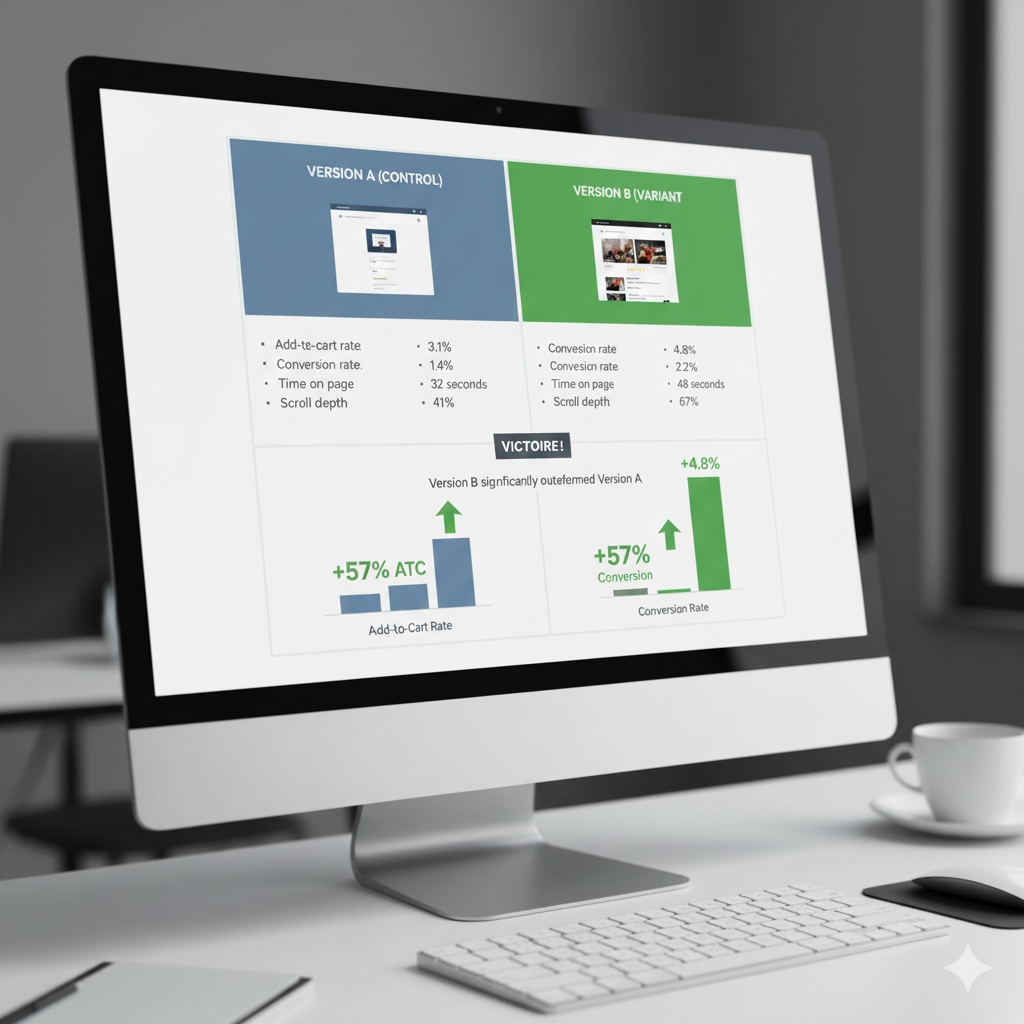
Version A (Control)
- Add-to-cart rate: 3.1%
- Conversion rate: 1.4%
- Time on page: 32 seconds
- Scroll depth: 41%
Version B (Variant)
- Add-to-cart rate: 4.8%
- Conversion rate: 2.2%
- Time on page: 48 seconds
- Scroll depth: 67%
📌 Key insight
Version B outperformed Version A across all metrics.
The improvements that made the biggest impact:
- More product images → higher engagement
- Customer ratings → increased trust
- Bullet-point descriptions → better for mobile users
- Stronger CTA → higher urgency and clarity
A two-proportion Z-test confirmed the results with p < 0.05, meaning they are statistically reliable.
Explore : Exploring AI in Social Media: Personalization, Bots & Content Moderation – Around Data Science
Why these insights matter for Algerian e-commerce
Based on dozens of local audits and user behavior patterns in Algeria, here’s why these changes work:
1. Algerian consumers rely heavily on visuals
Better images = higher confidence = more conversions.
2. Social proof is extremely influential
Ratings and reviews strongly reduce hesitation.
3. Short descriptions work better on mobile
Most Algerians shop from smartphones.
4. Strong CTAs increase engagement
Clear, benefit-oriented wording boosts click-through.
How to run your own A/B tests in Algeria
If you’re running an e-commerce store in Algeria, here’s a simple roadmap:
1. Focus on high-impact pages
Start with:
- Product pages
- Checkout
- Category pages
2. Test one variable at a time
Images, CTAs, layout, price formatting, delivery text, etc.
3. Use accessible tools
- VWO
- Firebase
- GA4 experiments
- Hotjar for behavior analytics
4. Let tests run long enough
7–14 days minimum (or until you reach significance)
5. Validate results statistically
Never rely on “looks better”, rely on data.
Bonus : 5 actionable tips for A/B testing in Algerian e-commerce
- Test mobile first (most traffic in Algeria comes from mobile).
- Experiment with price formats (e.g., 14,999 DA vs 14999 vs 14.999 DA).
- Try different delivery messages (“Fast delivery”, “Available today”, etc.).
- Use urgency carefully (limited stock, offer ends soon).
- Run new tests monthly, small improvements compound over time.
Learn more : A/B Testing: A Data-Driven Approach to Boost Fast-Food Sales – Around Data Science
Conclusion
A/B testing is one of the most effective ways to grow an online store in Algeria.
Real data shows that optimizing product pages, especially visuals, social proof, and call-to-action buttons, can significantly increase conversion rates.
If you want to stay competitive in Algeria’s growing e-commerce landscape, continuous testing is not optional…it’s essential.
Build a smarter, faster online store with Ayor.ai
If you’re looking to launch or optimize your e-commerce store without needing technical skills, try Ayor.ai.
Ayor.ai helps you:
- build your online store (like Shopify, but simpler)
- run A/B tests easily
- optimize product pages with AI
- automate daily operations
- grow your sales with data-driven tools
👉 Try it here: ayor.ai
FAQ : A/B testing in E-Commerce (Algeria edition)
1. What is A/B testing in e-commerce?
It’s the process of comparing two webpage versions to see which converts better.
2. How long should an A/B test run in Algeria?
Typically 7–14 days, depending on traffic volume.
3. What tools do Algerian businesses use for A/B testing?
VWO, Firebase, GA4, Hotjar, and ayor.ai (for automated optimization).
4. What should I test first on my store?
Images, CTAs, product descriptions, and price formatting.
5. Does A/B testing really increase sales?
Yes, when done consistently, it leads to ongoing conversion improvement and long-term growth.
👉 Start your journey to become a data-savvy professional in Algeria.
Subscribe to our newsletter, follow Around Data Science on LinkedIn, and join the discussion on Discord.



0 Comments