Predicting electricity consumption in Algeria using time series forecasting is no longer optional for energy stakeholders, it is a strategic necessity. Rapid urbanization, extreme climate conditions, and rising residential and industrial demand are putting unprecedented pressure on Algeria’s power grid.
For data scientists, engineers, and AI practitioners, this problem represents a high-impact, real-world application of forecasting models where technical rigor directly translates into national-scale outcomes.
This case-study-driven guide shows how advanced time series methods transform raw electricity data into reliable, actionable forecasts for Algeria’s energy sector.
TL;DR
- Algeria’s electricity demand shows strong seasonality, climate sensitivity, and cultural effects.
- SARIMA, LSTM, and Prophet each solve different parts of the forecasting problem.
- Feature engineering (temperature, Ramadan, weekends) is as important as model choice.
- Ensembles outperform single models in production.
- A real-world Algiers case study demonstrates operational value.
What is predicting electricity consumption in Algeria using time series forecasting?
Electricity consumption forecasting estimates future power demand from historical load data and external drivers such as weather and calendar effects.
In Algeria, forecasting must capture:
- Extreme summer cooling peaks
- Ramadan-driven behavioral shifts
- Regional climate diversity
- Long-term growth trends
Time series forecasting is uniquely suited because it models temporal dependence, seasonality, and trend dynamics explicitly.
Why electricity demand forecasting matters for Algeria
Accurate forecasts are foundational to national energy strategy.
Strategic impact
- Grid stability: Prevents blackouts during summer heatwaves
- Cost optimization: Reduces fuel waste and reserve overcapacity
- Policy planning: Supports renewable energy integration
- Industrial reliability: Ensures uninterrupted production
For Sonelgaz and policymakers, forecasting errors translate directly into economic loss or social disruption.
Understanding Algeria’s electricity consumption patterns
Seasonal and climatic effects
- Summer demand exceeds winter by 30–40%
- Coastal humidity amplifies cooling load
- Saharan regions show extreme temperatures but lower density
Cultural and religious drivers
- Ramadan shifts peak demand to evening hours
- Fridays differ from standard workdays
- Eid holidays introduce sharp anomalies
Economic structure
- Industrial baseload from oil and gas processing
- Rapid growth in residential appliance usage
- Low price elasticity due to subsidies
- Data preprocessing for Algerian electricity datasets
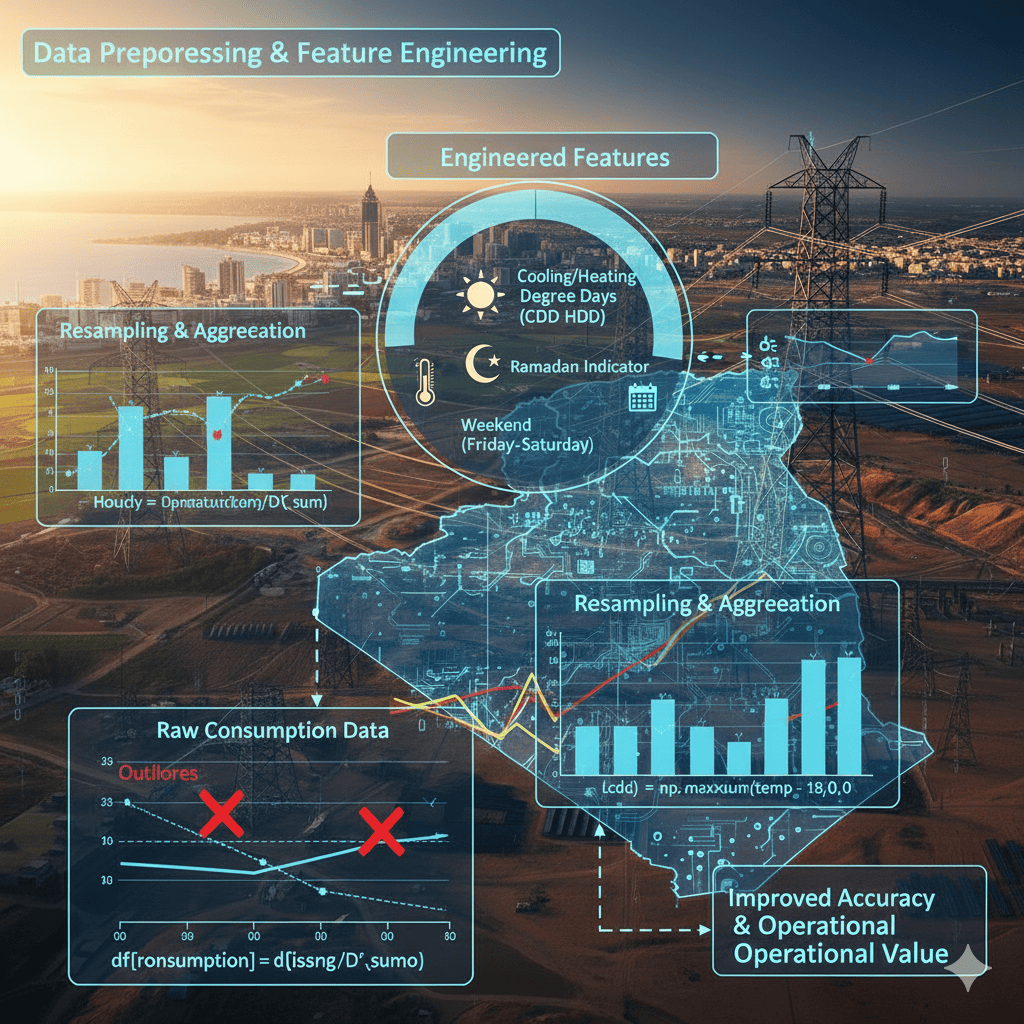
Handling missing values and outliers
Energy data often contains gaps and spikes.
df['consumption_mwh'] = df['consumption_mwh'].interpolate(method='time')Outliers are best handled using rolling statistics instead of naïve removal.
Learn more : Understanding the Interquartile Range (IQR) for Better Data Analysis – Around Data Science
Resampling and aggregation
Choose frequency by horizon:
- Hourly → operational forecasting
- Daily → tactical planning
- Monthly → strategic policy
daily = df.resample('D').sum()Feature engineering for energy forecasting
Key engineered features:
- Cooling degree days (CDD)
- Heating degree days (HDD)
- Ramadan indicator
- Weekend (Friday–Saturday)
- Lagged consumption values
df['cooling_degree_days'] = np.maximum(df['temperature'] - 18, 0)
df['is_ramadan'] = df.index.to_series().apply(is_ramadan).astype(int)
These features often improve accuracy more than changing models.
SARIMA modeling for Algerian electricity demand
SARIMA captures linear trends and strong seasonality.
model = SARIMAX(
    train['consumption_mwh'],
    order=(1,1,1),
    seasonal_order=(1,1,1,7)
)
results = model.fit()
When SARIMA works best
- Stable historical patterns
- Limited data availability
- Need for interpretability
LSTM networks for nonlinear consumption patterns
LSTMs excel when relationships become complex.
Why LSTM fits Algeria’s data
- Nonlinear temperature thresholds
- Compound effects (heat × Ramadan)
- Long-term dependencies
model = Sequential([
    LSTM(128, return_sequences=True),
    LSTM(64),
    Dense(1)
])
Multivariate LSTMs incorporating weather and calendar features significantly outperform univariate versions.
Discover : Beginner roadmap to deep learning 2026 : Tools, courses & Algeria – Around Data Science
Prophet for robust seasonal forecasting
Prophet decomposes:
- Trend
- Weekly seasonality
- Yearly seasonality
- Holiday effects
This aligns naturally with Algerian consumption drivers.
model = Prophet(holidays=dz_holidays)
model.add_regressor('temperature')
Prophet is particularly effective for:
- Rapid prototyping
- Sparse or noisy datasets
- Long-term planning
Model comparison and ensemble strategy
| Model | Strength | Limitation |
|---|---|---|
| SARIMA | Interpretable | Linear only |
| LSTM | High accuracy | Data-hungry |
| Prophet | Robust | Less granular |
| Ensemble | Most stable | More complex |
Ensembles consistently deliver the lowest error.
Read more : How to train, test & evaluate ML models step-by-step – Around Data Science
Case study: forecasting Algiers metropolitan electricity demand
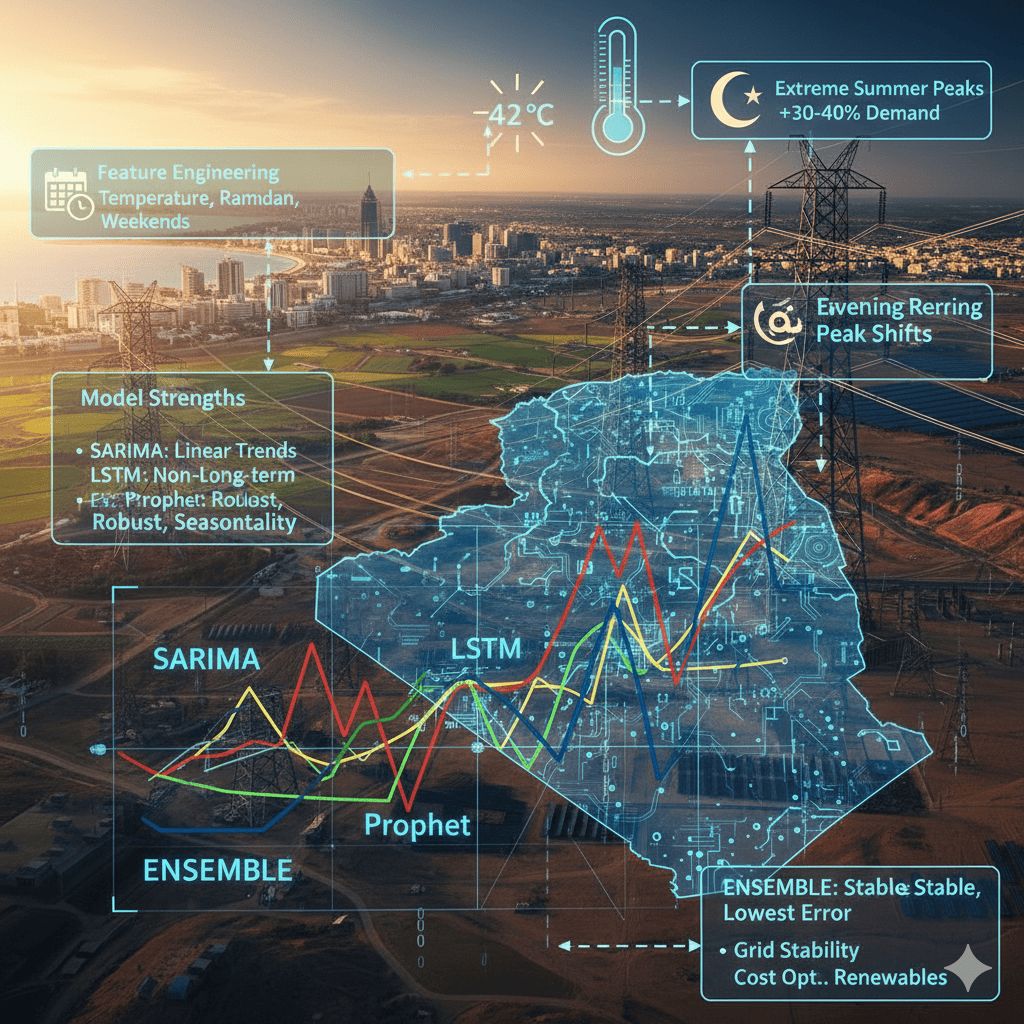
Algiers represents 15–20% of national consumption.
Key challenges
- Dense urban cooling load
- Industrial zones (Rouiba, Réghaïa)
- Coastal humidity effects
Hybrid solution
Prophet extracts trend and seasonality.
XGBoost models nonlinear weather interactions.
Result:
- Lower MAE than any single model
- Clear operational insights for peak management
Operational insights
- Demand spikes sharply above 30°C
- Ramadan evenings increase load by 15–20%
- Friday consumption drops 8–10%
7 bonus tips for predicting electricity consumption in Algeria using time series forecasting
- Forecast at wilaya level before national aggregation
- Use satellite weather data for sparse regions
- Monitor feature drift continuously
- Model gas availability for long-term forecasts
- Validate against grid capacity limits
- Use prediction intervals, not point estimates
- Retrain models automatically during heatwaves
FAQ
What is the best model for Algerian electricity forecasting?
There is no single best model. Ensembles of SARIMA, LSTM, and Prophet perform best.
How much data is required?
At least 2–3 years for seasonal models; 3–5 years for deep learning.
How do I model Ramadan correctly?
Use Islamic calendar indicators and interaction features.
What accuracy is realistic?
- Short-term: 2–5% MAPE
- Medium-term: 5–10%
- Long-term: 10–20%
Is weather really that important?
Yes. Temperature often explains 30–50% of variance.
Conclusion for predicting electricity consumption in Algeria using time series forecasting
- Electricity forecasting is a national-scale optimization problem.
- Algeria’s demand patterns require culturally and climatically aware models.
- SARIMA, LSTM, and Prophet each play a complementary role.
- Production systems must handle drift, retraining, and uncertainty.
Mastering predicting electricity consumption enables engineers and data scientists to build resilient, future-proof energy systems.
👉 Join the Around Data Science community on Discord, subscribe to our newsletter, and follow us on LinkedIn.
Key Takeaways
- Algeria’s electricity demand is highly seasonal and climate-driven
- Feature engineering is critical for accuracy
- Ensembles outperform single models
- Forecast uncertainty must always be quantified
- Domain knowledge is as important as algorithms


0 Comments