

Fraud detection with machine learning is no longer optional for data-driven organizations; it’s a critical capability for protecting revenue and trust at scale. In this hands-on case study, you’ll see how Python, data science workflows, and ML models come together to detect fraudulent behavior in real-world datasets.
TL;DR
- Fraud detection relies on supervised and unsupervised machine learning models.
- Class imbalance is the core challenge in fraud datasets.
- Tree-based models and anomaly detection perform best in practice.
- Python tools like scikit-learn, pandas, and imbalanced-learn are essential.
- Evaluation must focus on recall, precision, and business cost, not accuracy.
What is fraud detection with machine learning?
Fraud detection with machine learning involves using algorithms to identify suspicious or fraudulent transactions based on historical data automatically.
Unlike rule-based systems, ML models:
- learn hidden patterns,
- adapt to new fraud strategies,
- scale to millions of transactions.
Typical fraud scenarios
- Credit card fraud
- Insurance fraud
- Online payment fraud
- Account takeover
- Fake account creation
For Algerian fintech startups, banks, and e-commerce platforms, these systems are becoming strategic assets.
Check : A/B Testing in E-commerce : What You Can Learn from Algerian Real Data – Around Data Science
Why fraud detection matters in modern data systems
Fraud has three defining characteristics:
- Rare events (often <1% of data)
- Highly asymmetric costs
- Adaptive adversaries
Traditional systems fail because:
- static rules are easy to bypass,
- manual reviews don’t scale,
- fraud patterns evolve fast.
Machine learning solves these issues by continuously learning from data.
How fraud detection with machine learning works
At a high level, the pipeline looks like this:
- Data collection
- Feature engineering
- Model training
- Model evaluation
- Deployment & monitoring
Supervised vs unsupervised approaches
| Approach | When to use | Examples |
|---|---|---|
| Supervised | Labeled fraud data available | Logistic Regression, Random Forest |
| Unsupervised | No labels or evolving fraud | Isolation Forest, Autoencoders |
| Semi-supervised | Few fraud labels | One-Class SVM |
Practical case study: fraud detection using Python

Let’s walk through a real-world workflow using Python.
Dataset overview
We assume a transaction dataset with:
- amount
- transaction time
- merchant category
- user behavior features
- fraud label (0 = legit, 1 = fraud)
This structure mirrors datasets used by banks and payment gateways.
Step 1: loading and exploring the data
import pandas as pd

df = pd.read_csv("transactions.csv")
df.head()
Key checks:
- Missing values
- Class imbalance
- Feature distributions
df['is_fraud'].value_counts(normalize=True)
Expect severe imbalance (e.g., 0.5% fraud).
Step 2: handling class imbalance
This is the core challenge of fraud detection with machine learning.
Popular strategies:
- Resampling (SMOTE, undersampling)
- Class-weighted models
- Anomaly detection
from imblearn.over_sampling import SMOTE

X = df.drop("is_fraud", axis=1)
y = df["is_fraud"]

smote = SMOTE(random_state=42)
X_res, y_res = smote.fit_resample(X, y)
Step 3: model selection and training
Tree-based models dominate fraud detection.
Random Forest example
from sklearn.ensemble import RandomForestClassifier

model = RandomForestClassifier(
    n_estimators=200,
    class_weight="balanced",
    random_state=42
)

model.fit(X_res, y_res)
Why Random Forest?
- handles non-linearity,
- robust to noise,
- interpretable feature importance.
Step 4: evaluation metrics that matter
Accuracy is misleading.
Focus instead on:
- Precision
- Recall
- F1-score
- ROC-AUC
- PR-AUC
Dive deeper : Prediction Metrics: A Deep Dive into Regression & Classification (with Code) – Around Data Science
from sklearn.metrics import classification_report

y_pred = model.predict(X_test)
print(classification_report(y_test, y_pred))
High recall reduces missed fraud.
High precision reduces false alarms.
Step 5: model explainability
Regulatory environments require transparency.
import shap

explainer = shap.TreeExplainer(model)
shap_values = explainer.shap_values(X_test)
Explainability helps:
- compliance,
- fraud analyst trust,
- model debugging.
Real-world deployment considerations
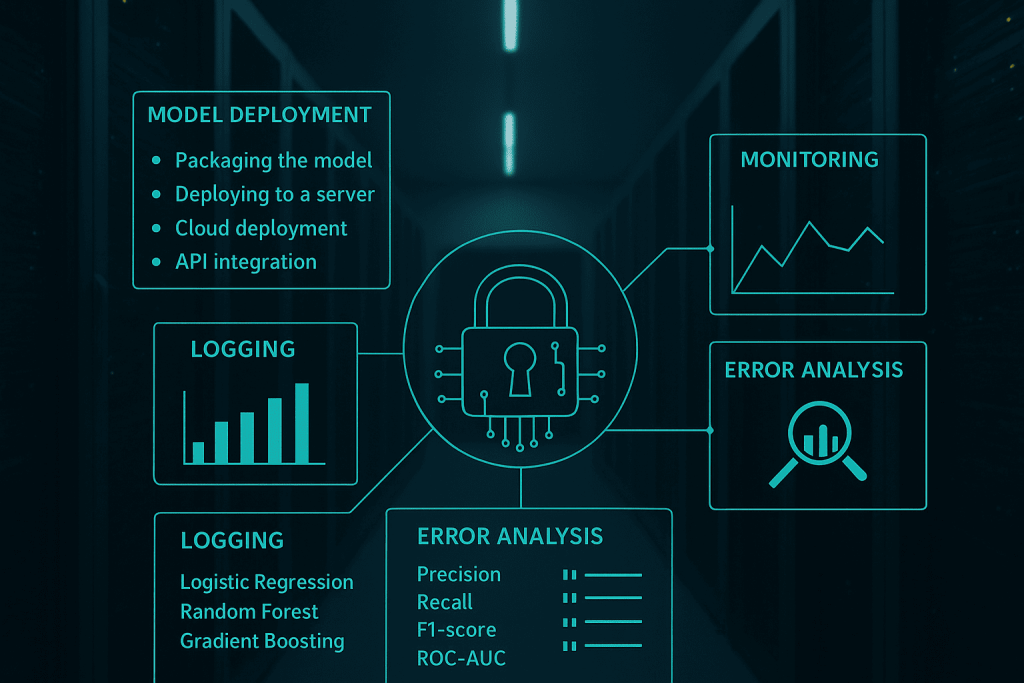
Fraud detection doesn’t stop at training.
Production challenges
- Data drift
- Concept drift
- Latency constraints
- Feedback loops
Best practices
- Retrain frequently
- Monitor precision/recall weekly
- Add human-in-the-loop review
- Log model decisions
Turning fraud detection models into real-world applications
Building a fraud detection model in Python is the exciting first step. The real challenge, and opportunity, is turning that model into a system your team or customers can actually use in production.
This post demonstrates fraud detection fundamentals. For production-grade systems that handle real transactions at scale, professional integration is recommended.
Prodysoft helps fintech startups and data-driven teams deploy fraud detection systems in regulated environments, processing thousands of transactions daily. They transform ML pipelines into fully operational web solutions, including:
- real-time fraud scoring APIs,
- internal dashboards for fraud analysts,
- secure web applications for monitoring transactions,
- automated workflows powered by machine learning and AI.
How Prodysoft supports fraud detection projects
If you’re reading this tutorial as part of a production project, here’s how Prodysoft can help:
- 🧩 Custom web applications for fraud monitoring and investigation
- 📊 Analytics dashboards to track recall, precision, alerts, and model drift
- ☁️ Scalable cloud deployment for ML-powered systems (AWS, GCP, Azure, or on-premise)
- 🤖 AI & automation for alerts, workflows, and decision support
- 🔐 Secure infrastructure for sensitive financial data and compliance requirements
- 🌐 SEO-ready platforms for fintech products and services
Whether you’re using scikit-learn, XGBoost, TensorFlow, or PyTorch, and whether you need cloud deployment or on-premise infrastructure, they adapt to your existing ML stack and business constraints, from prototype to production.
👉 Limited offer: Fill this form now for 5% off + priority project review: 🔗 [Google Form – Prodysoft lead collection]
💡 Ideal if you want to move from a Python notebook to a real-world fraud detection system used by teams or customers.
Pros and cons of machine learning for fraud detection
| Pros | Cons |
|---|---|
| Scales automatically | Needs quality data |
| Adapts to new fraud | Sensitive to drift |
| Reduces manual effort | Requires monitoring |
| High detection accuracy | Complex pipelines |
Fraud detection bonus tips for machine learning
- Always baseline with logistic regression.
- Optimize for business cost, not metrics.
- Combine rules + ML for best results.
- Use temporal features aggressively.
- Monitor feature importance drift.
FAQ: Fraud detection with machine learning
1. Which ML algorithm is best for fraud detection?
Tree-based models and gradient boosting dominate due to robustness and interpretability.
2. Is unsupervised learning enough?
Not alone. It works best combined with supervised models.
3. How much data is needed?
Thousands of transactions minimum, millions ideally.
4. How do you reduce false positives?
Threshold tuning, better features, and cost-sensitive learning.
5. Can deep learning help?
Yes, especially with sequences and graph-based fraud.
6. Is real-time fraud detection possible?
Yes, with optimized models and streaming pipelines.
Conclusion for fraud detection with machine learning
Fraud detection with machine learning is a high-impact application where data science meets real business value.
Summary:
- Fraud data is imbalanced and adversarial
- Python offers a complete ML ecosystem
- Model evaluation must align with business cost
- Monitoring and explainability are mandatory
The future of secure digital systems depends on fraud detection with machine learning.
👉 Join the Around Data Science community (Discord), subscribe to our newsletter, and follow us on LinkedIn.
Key Takeaways
- Fraud detection is a core ML use case.
- Class imbalance defines the problem.
- Python and tree-based models lead in practice.
- Evaluation metrics must reflect business reality.
- Deployment and monitoring are as important as training.



0 Comments